Word of the Hesychastirion
The Dormition of the Most Holy Theotokos
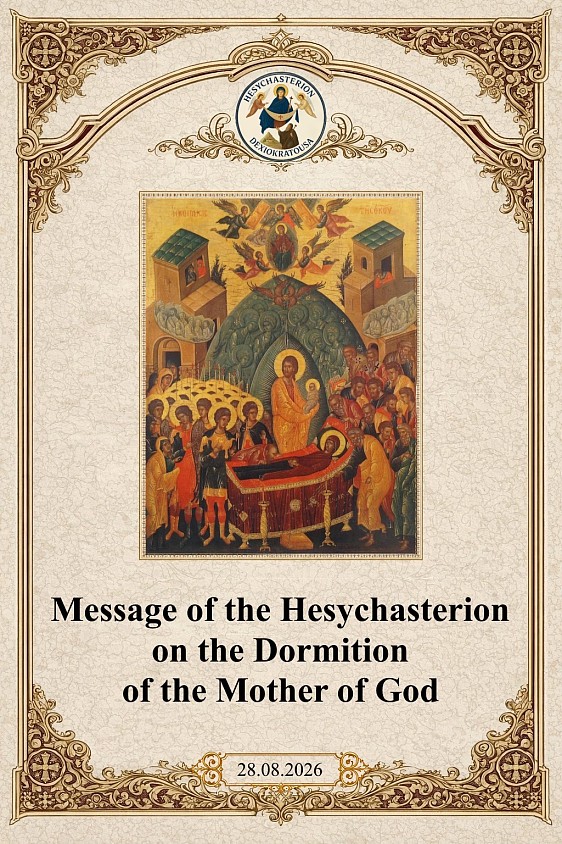
On the feast of the Dormition of the Most Holy Theotokos, with reverence we bow before the great mystery of Her falling asleep and glorify the Lord, Who glorified His Most Pure Mother.
She, Who throughout Her life surrendered Herself wholly to the Lord, remains for us in Her Dormition an image of perfect humility, purity, and surrender to the will of God.
The Most Holy Theotokos, protectress of monastics and refuge of all who flee to Her, does not abandon those who walk the path of prayer and stillness.
To Her holy protection we entrust ourselves, our brotherhood, and all who call upon Her name with faith and love.
May the Lord, through the prayers of His Most Pure Mother, grant us peace of heart, watchfulness, humility, and the grace of unceasing prayer.
Most Holy Theotokos, save us.
Hesychasterion Dexiokratousa
28.08.2026
1400 Years of the Akathist Hymn to the Most Holy Theotokos
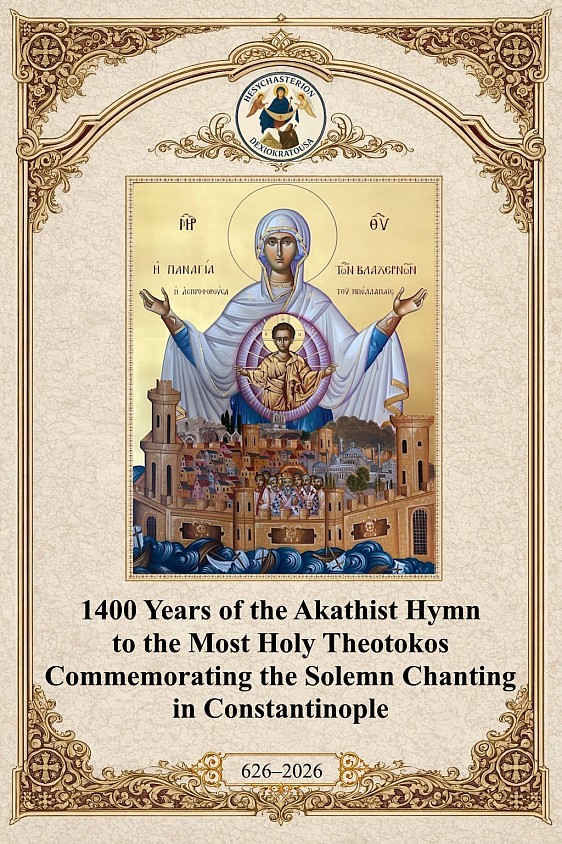
A Memory of Thanksgiving That Lives in the Church
In 2026, the Orthodox Church commemorates a remarkable historical anniversary: 1,400 years since the solemn chanting of the Akathist Hymn while standing in Constantinople.
The anniversary commemorates the events of 7 August 626, when, during the Sacred Vigil in the Church of the Most Holy Theotokos at Blachernae, the Akathist Hymn was solemnly chanted while the faithful stood, as an expression of thanksgiving to the Most Holy Theotokos for the deliverance of Constantinople from a perilous siege. The event is expressly commemorated by the Ecumenical Patriarchate throughout 2026.
“To You, the Champion Leader…”
The Akathist begins with a hymn of thanksgiving to the Most Holy Theotokos, whom the Church venerates as the Protectress and Intercessor of Christians.
The historical events of 626 became part of the living memory of the Church. The thanksgiving offered at that time continues to resound in Orthodox worship to this day.
The Akathist, therefore, is not merely a monument of the distant past. It remains a living prayer through which the Church continues to turn to the Most Holy Theotokos.
In its Patriarchal and Synodal Encyclical of 2026, the Ecumenical Patriarchate describes the Akathist as a radiant masterpiece of ecclesiastical poetry and a profound expression of the Church’s faith in the mystery of the Incarnation and in the unique role of the Most Holy Theotokos. It also emphasizes the enduring place of the Akathist in Orthodox liturgical and spiritual life.
The Mystery of the Akathist
At the heart of the Akathist lies the mystery of the Incarnation of the Son of God.
Through its kontakia and oikoi, the Church contemplates the Most Holy Virgin Mary as the Mother of God, through whom the ineffable mystery of the coming of God the Word in the flesh was revealed to the world.
For this reason, the veneration of the Theotokos in the Akathist cannot be separated from the Christological faith of the Church. Every honor offered to the Most Holy Theotokos points toward the mystery of Christ, whom she received in her womb and bore for the salvation of the world.
This is one of the reasons why, fourteen centuries later, the Akathist remains so deeply cherished by Orthodox Christians.
From Constantinople to the Universal Church
Historically, the Akathist is inseparably connected with Constantinople and the Church of the Blachernae.
Yet its prayerful life has long transcended the boundaries of one city.
Throughout the centuries, the Akathist spread throughout the Orthodox world and became part of the liturgical and devotional life of Local Churches, monasteries, parishes, and Christian families.
It is chanted in churches and monasteries; it is read in solitude and in the home. Before its ancient words, Christians bring their thanksgiving, their sorrows, their petitions, and their hope.
Thus, an ancient hymn becomes the prayer of every generation.
1,400 Years — and the Prayer Continues
It is especially meaningful that this anniversary is being commemorated in our own time.
We live in an age marked by anxiety, division, war, loneliness, and many forms of human suffering. For this reason, the ancient prayer of the Church to the Most Holy Theotokos does not seem distant from the modern person.
On the contrary, it once again reminds us of thanksgiving amid trials, hope amid sorrow, and the enduring reality of prayer.
The Akathist teaches us not only to ask for deliverance, but also, above all, to give thanks.
The historical events of 626 became for Constantinople a testimony of deliverance. Yet the Church preserved not only the memory of the City's deliverance. She preserved, above all, the prayer of thanksgiving.
Fourteen centuries later, that prayer continues to resound.
In Thanksgiving to the Most Holy Theotokos
For the Hesychasterion of the Most Holy Theotokos “Deksiokratusa”, the 1,400th anniversary of the solemn chanting of the Akathist Hymn has a particular spiritual significance.
As a hesychasterion dedicated to the Most Holy Theotokos, we gratefully join the wider Orthodox commemoration of this remarkable anniversary.
May the words of the ancient Akathist continue to be a source of consolation, strength, and hope for Orthodox Christians.
May the prayer of the Church teach the human heart once again to give thanks to God — both in joy and amid trials.
And may the Most Holy Theotokos, whom the Church venerates as the Protectress and Intercessor of Christians, never abandon those who turn to Her with faith.
Fourteen centuries have passed — yet the Church’s hymn of thanksgiving has not fallen silent.
Hesychasterion of the Most Holy Theotokos “Deksiokratusa”
The Transfiguration of the Lord: A Hesychast Contemplation
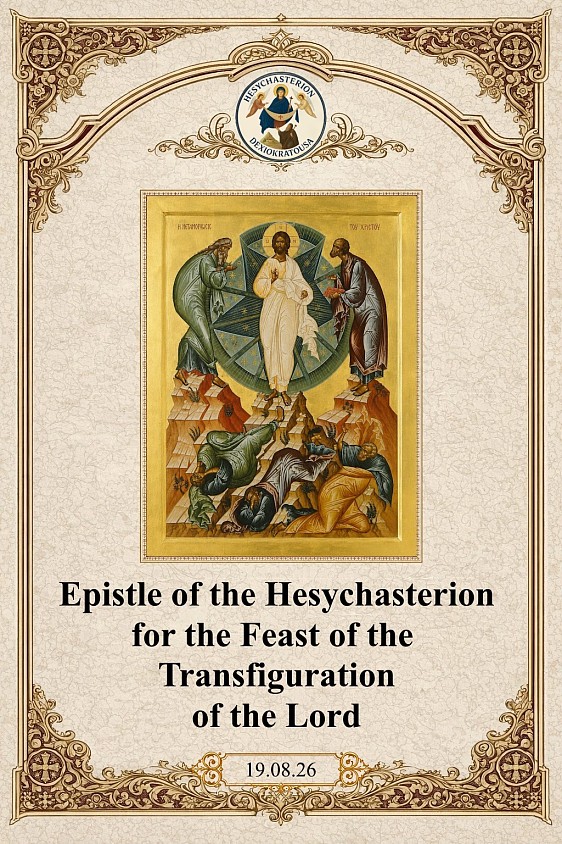
The Feast of the Transfiguration of the Lord opens before the human heart a mystery that cannot be comprehended by reason alone. Christ ascends the mountain not in order to show His disciples something external and passing, but to reveal for a moment that which eternally abides in Him — the divine light of His glory.
The Gospel tells us that the face of the Saviour shone, His garments became white as light, and Moses and Elijah appeared beside Him. The disciples beheld what had previously been hidden from their bodily eyes. Yet it is especially important to understand: Christ did not become different on Tabor — the eyes of those who beheld Him were changed.
So too in the spiritual life: the purpose is not to change God, but to purify the heart so that it may receive the divine light.
Mount Tabor — the ascent of the heart
The Lord ascends the mountain with Peter, James, and John. In this ascent the Church sees an image of the inner journey of man.
While the mind is scattered, while the heart is occupied with countless earthly thoughts, while a person lives entirely according to outward movement, he scarcely notices the presence of God. But when the soul begins to withdraw from distraction, to enter into silence, to attend to itself, and to call upon the name of Christ, another dimension of being gradually opens before it.
The hesychast tradition knows this path as νήψις — watchfulness, as attention of the mind and guarding of the heart.
Man ceases to seek God only outside himself. He begins to stand before Him in the depths of his own heart.
Not every silence is stillness. One may remain in complete outward silence while carrying within oneself the noise of an entire world. True stillness begins not when everything around us becomes quiet, but when the mind ceases to scatter itself and returns to God.
“Lord, it is good for us to be here”
Having seen the divine glory, the Apostle Peter says:
“Lord, it is good for us to be here.”
These words have a profound meaning for every soul that has even once touched the silence of prayer.
A person may spend many years seeking happiness in earthly circumstances, recognition, success, human relationships, knowledge, and achievement. But when the heart experiences, even for a moment, the peace that comes from God, it understands that nothing else can give what it is truly seeking.
The light of Tabor does not entertain man. It leads him to peace.
For this reason the hesychast does not continually seek extraordinary spiritual experiences. He does not pursue visions, sensations, or inward phenomena. His path is much quieter: to stand before God, to guard the mind, patiently to purify the heart, and to call upon the name of Jesus.
The Light that does not belong to this world
The light of Tabor is not created light. It is not merely a physical phenomenon or symbolic illustration. In Orthodox theology, the Transfiguration reveals the action of divine grace, through which man may participate in God without becoming God according to essence.
The Holy Fathers expressed this mystery especially clearly in their teaching concerning the divine energies.
Man cannot become God by nature. Yet he is called to become a partaker of divine life by grace.
Here lies the great mystery of deification — θέωσις.
The Transfiguration of the Lord is therefore not merely a remembrance of an evangelical event, but also a revelation of the destiny of man himself.
Christ reveals on Tabor not only His glory. He reveals what man is called to become.
Why the light comes after the ascent
The way to Tabor passes through ascent.
In the spiritual life there is no true light without repentance, no inner peace without struggle with the thoughts, and no purity of heart without patience.
Man wishes to see the light immediately, but the Lord first leads him up the mountain.
This mountain may be very simple.
For one person — several minutes of silent prayer.
For another — patience in suffering.
For another — forgiveness of someone who has caused pain.
For another — refraining from a word one wishes to speak.
For a monk — returning the mind to prayer after countless distractions.
It is through these small labours that man gradually ascends from the outward man to the inward.
Thus the hesychast path is not an escape from the world for the sake of escape itself. It is a return of man to his true inwardness — to the place where he can hear God anew.
“This is My beloved Son”
Over Tabor the voice of the Father is heard:
“This is My beloved Son; hear Him.”
This is perhaps the most important word of the feast.
Not “see” — but “hear.”
The Transfiguration begins with the contemplation of light, but continues in obedience to Christ.
A person may know much about God and yet not live with God. One may read Holy Scripture and still remain inwardly deaf to its call.
Therefore the Lord says: hear Him.
To hear Christ means to allow His word to correct us.
To hear means to renounce our own will where it resists God’s will.
To hear means to learn silence when we wish to justify ourselves.
To hear means to preserve love where the heart wishes to become hardened.
Thus the light of Tabor becomes not merely an inward experience, but a way of life.
The Transfiguration begins in the heart
The Holy Apostle Paul speaks of the transformation of man:
“We all… are being transformed into the same image from glory to glory.”
This movement does not happen in a single moment.
Man is purified gradually.
First he notices his own distraction. Then he begins to notice his thoughts. Then he learns not to consent to them. Gradually the mind becomes more attentive, the heart quieter, and prayer simpler.
And then man begins to understand the teaching of the ancient Fathers concerning the guarding of the heart.
True prayer becomes not a multitude of words, but the turning of the whole being toward God.
“Lord Jesus Christ, Son of God, have mercy on me.”
This short invocation may become for the monk the breath of his inner life.
Not because the mere pronunciation of these words possesses any magical power, but because the name of Christ continually brings the mind back to Christ Himself.
And as the mind returns to Him again and again, the heart gradually becomes free from the dominion of distraction.
Tabor after Golgotha
There is another mystery.
The Transfiguration takes place shortly before the suffering of the Saviour.
Tabor cannot be separated from Golgotha.
The light cannot be separated from the Cross.
Therefore the spiritual life cannot be built upon consolation alone. Whoever wishes to enter the light of Christ must be prepared to follow Christ even when the path becomes dark.
Sometimes the Lord allows a person to experience peace and grace in order to strengthen him.
Then He may once again permit inward dryness, struggle, trial, and silence.
Not because He has abandoned him, but because He teaches him to love God not only for the consolation that he can feel.
Tabor strengthens the disciple for Golgotha.
And every true spiritual consolation must ultimately lead a person to greater faithfulness, greater love, and greater humility.
The Light of Christ amid the darkness of the world
This is especially evident in our own time.
The world is filled with noise, fear, conflict, information, and constant movement. The human mind scarcely has an opportunity to become still.
Yet the Church continually reminds us: the light of Christ does not depend upon the condition of the world.
It does not become weaker because darkness surrounds us.
A holy person is not one who never sees darkness, but one who preserves his orientation toward the Light even in the midst of darkness.
For this reason hesychast stillness has a particular significance today.
It bears witness that man does not have to live only by what is happening around him.
One may close the door of the cell.
One may cease unnecessary speech.
One may put aside the telephone.
One may stand before an icon.
One may quietly pronounce the name of Christ for several minutes.
And in this small stillness discover once again that God has not departed.
He was near.
It was simply that the heart was too occupied to notice.
“Let Your everlasting Light shine also upon us sinners”
On the Feast of the Transfiguration, the Church asks that the light of Tabor may shine also within our hearts.
But to ask for light is at the same time to ask for purification.
For the light of God reveals not only beauty, but also that within us which still needs healing.
The closer man comes to the light, the more clearly he sees his own weakness.
Therefore the true experience of divine light never gives birth to pride.
It gives birth to humility.
A person who has glimpsed even a small part of the beauty of God can no longer boast in himself.
He can only say:
“Lord, I have nothing of my own. Everything good is from You.”
Thus Tabor leads not to spiritual self-satisfaction, but to thanksgiving.
Conclusion
The Transfiguration of the Lord is a feast of light, but even more, it is a feast of hope.
Christ reveals His glory to the disciples before His Passion, so that they may know: beyond the Cross stands the Resurrection; beyond death, life; beyond darkness, light; beyond repentance, purification; beyond faithfulness, deification.
And therefore every Christian is called to his own Tabor.
Not necessarily to an extraordinary experience.
Not necessarily to a vision.
Not necessarily to a sensible experience of light.
But to the quiet inward transformation that begins with small things: repentance, attention, prayer, humility, patience, and love.
When a person returns his mind to God day after day, the heart gradually becomes capable of receiving that which was previously hidden from it.
Then the words of the Psalmist are fulfilled:
“In Your light we shall see light.”
May the Lord enlighten our darkened hearts, strengthen us in the guarding of the mind, grant us the spirit of repentance and inner stillness, and lead each one of us from the small spark of faith toward the fullness of that uncreated Light which shone forth upon Tabor and shall never fade.
Lord Jesus Christ, true Light, enlighten our hearts and transform us according to Your image. Amen.
Igumen
of the Holy Hesychasterion
of the Holy Theotokos “Dexiokratousa”
The Holy Chief Apostles Peter and Paul
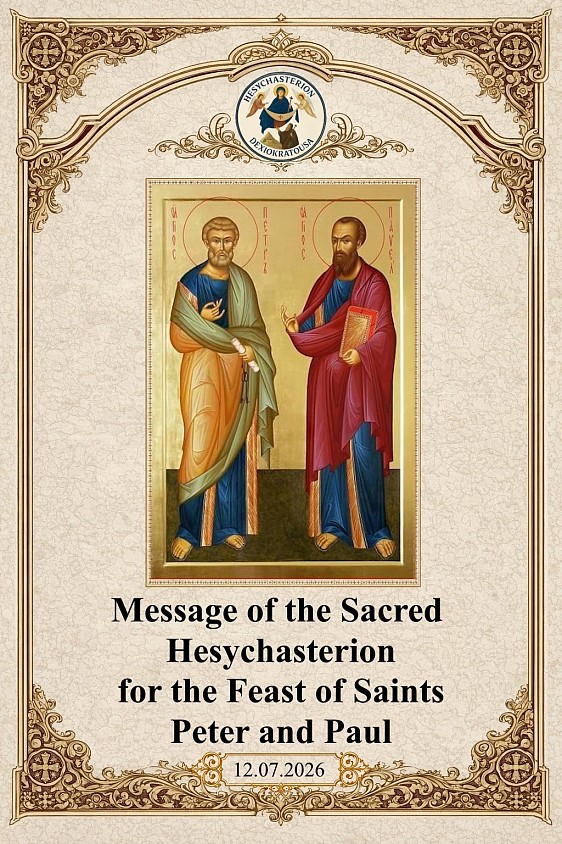
On the feast of the Holy Chief Apostles Peter and Paul, the Holy Church prayerfully glorifies these two great disciples of Christ. One was a simple fisherman, the other an educated Pharisee. One denied the Lord, the other persecuted the Church. Yet both were transformed by the grace of God.
Herein lies a great hope for every person: holiness is born not from human perfection, but from a repentant heart wholly devoted to God.
The Apostle Peter teaches us humility, while the Apostle Paul bears witness to the power of divine grace, which is able to transform every human soul.
The Hesychast tradition reminds us that the path of the Apostles continues in prayer, repentance, and the unceasing invocation of the Name of Jesus Christ.
Through the prayers of the Holy Chief Apostles Peter and Paul, may the Lord strengthen His Holy Church, grant peace to our suffering world, and bestow upon each of us the spirit of humility, repentance, and love for Christ.
Hesychasterion Dexiokratousa
12.07.26
Message of the Hesychasterion for Pentecost
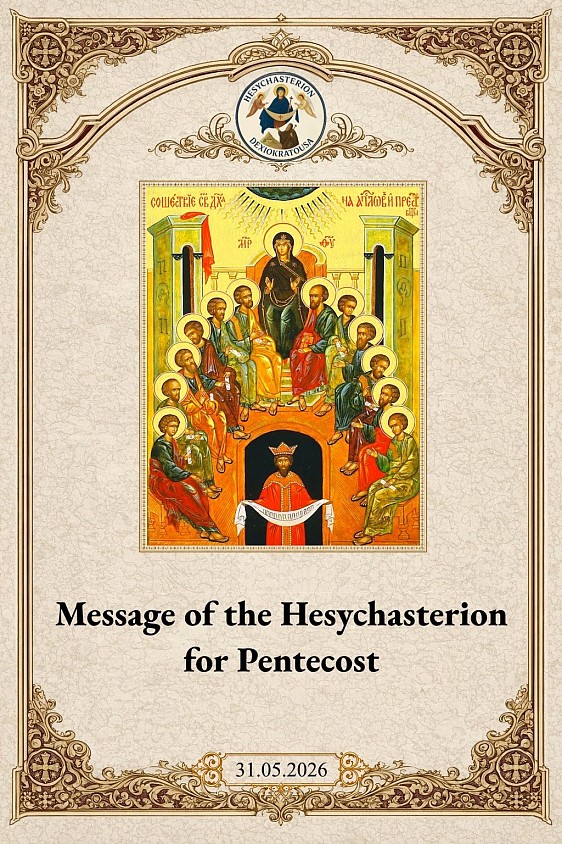
The Holy Trinity is not an object of human reasoning, but a life into which man is called to enter through purification of the heart, prayer, and the grace of the Holy Spirit. For God reveals Himself not to the curious mind, but to the humble heart.
The Father is the Beginning without beginning.
The Son is the eternal Word of the Father.
The Holy Spirit is the Comforter and Giver of Life, proceeding from the Father.
And the Trinity is not divided, for It is one in essence, nor is It confused, for the Persons abide truly and ineffably.
Therefore every soul wishing to draw near to God must first learn silence. For the noise of passions makes the heart incapable of receiving the visitation of God. As troubled water cannot reflect the sunlight, so the heart filled with thoughts cannot receive the gentle breath of grace.
The Holy Fathers did not theologize from book knowledge, but from purification of the mind. Therefore Saint Gregory the Theologian said that only the one who has first purified himself may speak of God. For true theology is born of prayer.
When the mind descends into the heart and cries: “Lord Jesus Christ, have mercy on me,” then little by little a man begins to understand that God is not a distant idea, but a living reality dwelling near the contrite heart.
And as one sun gives the world light, warmth, and life, so the Most Holy Trinity — Father, Son, and Holy Spirit — illumines the purified soul with one Divine Light. But this Light cannot be seen without repentance, for the proud mind remains outside the mystery.
Thus the feast of Pentecost is not only the remembrance of the descent of the Holy Spirit upon the Apostles, but also a reminder to every person that the heart must become an upper room capable of receiving the fire of grace.
If a man keeps the remembrance of God, loves silence, avoids judgment of others, and compels himself to prayer, then the grace of the Most Holy Trinity begins quietly to act within him. Not in the noise of the world, nor in the pride of knowledge, but in the hidden depth of the inner man.
May our mind and heart be turned toward the Most Holy Trinity — the Father, the Son, and the Holy Spirit. And may we learn to seek not earthly consolation, but the Heavenly Kingdom, which begins already here — in the purified heart filled with peace, prayer, and love.
O Most Holy Trinity, our God, glory be to Thee.
Hesychasterion Dexiokratousa
31.05.2026
Message of the Hesychasterion for the Ascension of the Lord
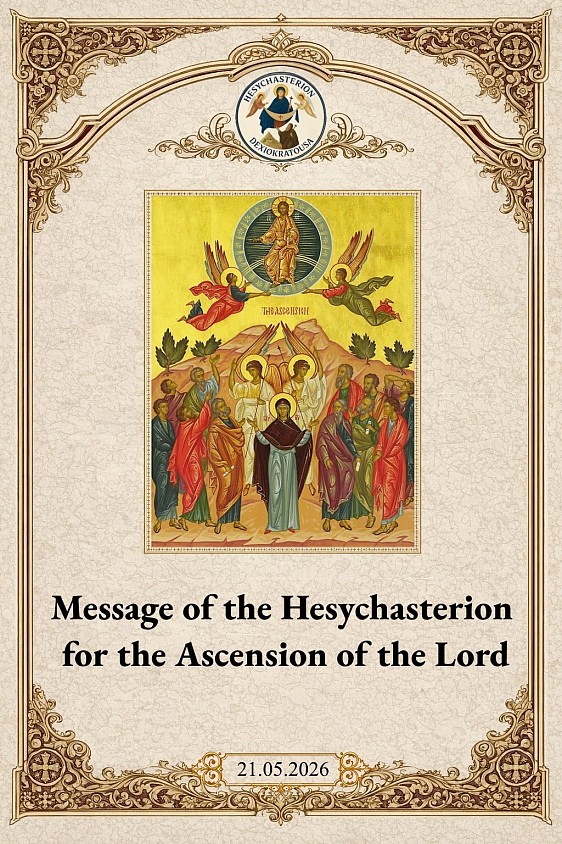
The Ascension of the Lord is not the departure of Christ from the world, but the opening of the path into Heaven within.
For the Lord ascended not in order to abandon the earth, but to make the human heart a throne of His presence.
Before the Ascension, the disciples sought Christ with their eyes; after the Ascension, they came to know Him in the Holy Spirit, in the depth of prayer, in the breaking of the heart, in the silence of the inner man.
Thus hesychia is not an escape from the world, but the ascent of the mind toward God through repentance and humility.
And if the heart is cleansed from the noise of the passions, then within it shall quietly shine the light of the Heavenly Kingdom.
Christ ascends, that man also may remember his heavenly homeland.
May our mind be where Christ abides, and our heart become a temple of peace, prayer, and love.
Blessed Feast of the glorious Ascension of the Lord.
Hesychasterion Dexiokratusa
21.05.2026
Greeting of the Hesychasterion to His Beatitude Patriarch Shio III
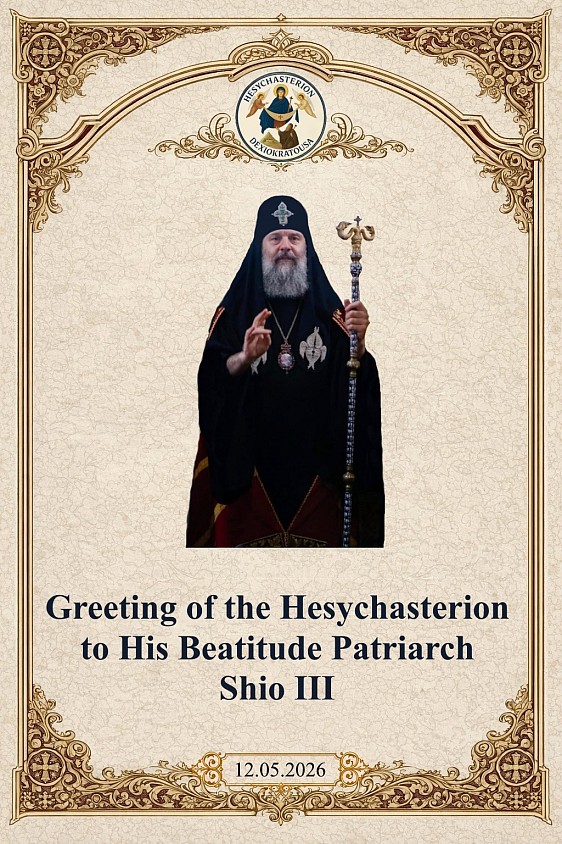
The Hesychasterion “Panagia Dexiokratousa” prayerfully congratulates His Beatitude Shio III upon his election and enthronement to the Patriarchal Throne of the Holy Georgian Orthodox Church.
May the Lord strengthen his primatial ministry in the peace and unity of the Church.
Hesychasterion Dexiokratusa
12.05.2026
Hesychasterion’s Messagefor the Annunciation of the Most Holy Theotokos and the Bright Resurrection of Christ
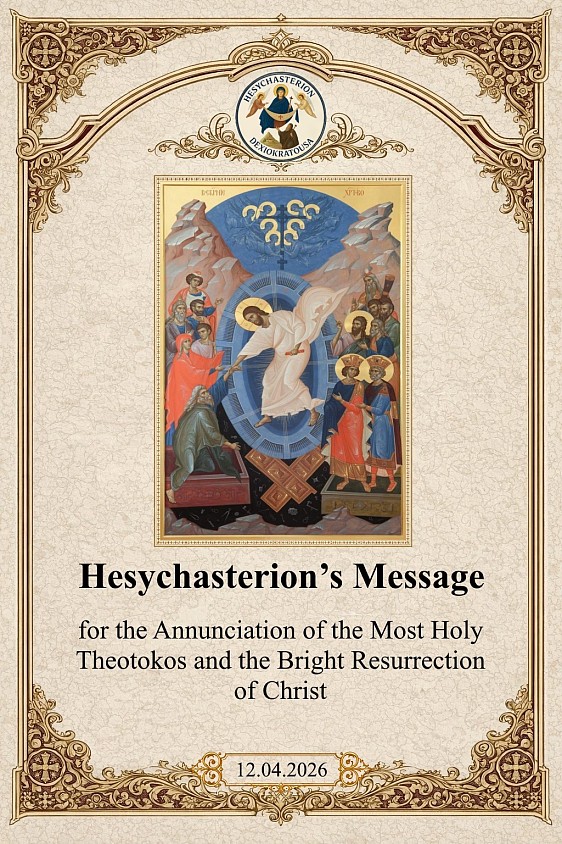
Beloved in Christ,
Now, in the holy days of the Annunciation and the Bright Resurrection of Christ, the Holy Spirit has united heaven and earth, proclaiming to us the incarnation of the Word of God and the mystery of salvation of the human race through our Lord Jesus Christ.
May your heart be a temple of the Holy Spirit, where the fear of God restrains every evil thought, and the joy of the Resurrection restores the spirit of purity, humility, and spiritual diligence.
May the Tabor Light illumine the Holy and Great Church of Christ with peace, unity, and prayer, establishing in every believer freedom from passions, inner stillness, and unceasing elevation of the spirit to the Lord.
With blessing and prayer,
Hesychasterion Dexiokratusa
April 12, 2026
Official Condolences on the Repose of Catholicos-Patriarch of All Georgia Ilia II
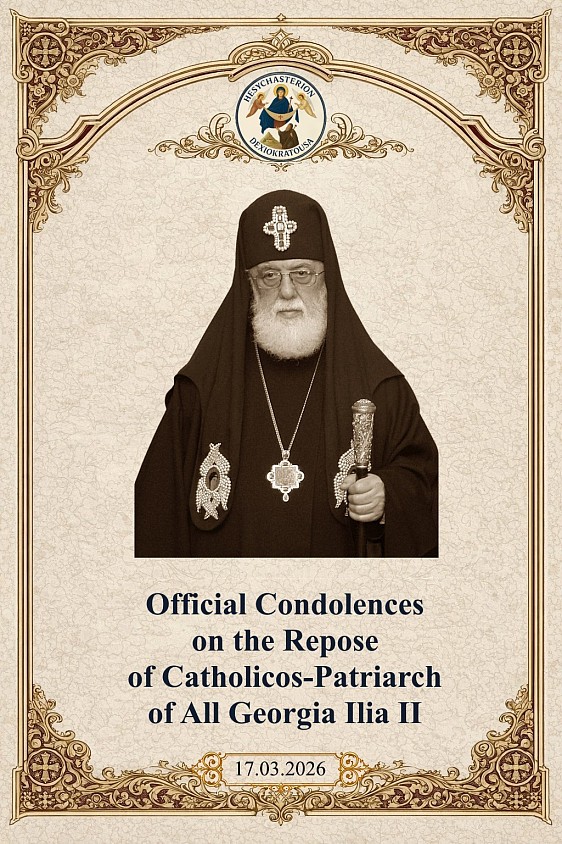
With humility and prayerful silence, we offer our condolences to the Georgian Patriarchate on the repose of the great elder — Ilia II, Catholicos-Patriarch of All Georgia.
Sharing in the sorrow of Orthodoxy, in the Hesychasterion we offer our prayers for the repose of the soul of the newly reposed Patriarch in the dwellings of the righteous.
May the Most Holy Theotokos grant Her heavenly consolation to the Holy Church of Georgia in this time of trial.
Memory eternal to him.
Hesychasterion Dexiokratousa
17.03.2026
Message of the Hesychasterion for the Beginning of Great Lent
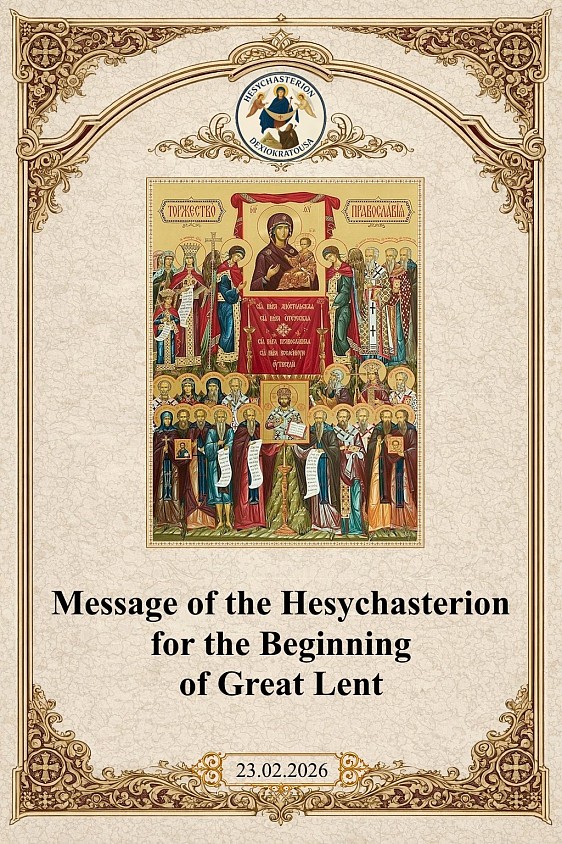
Great Lent is a time for the mind to return to its source.
For where the mind is scattered, there the person is outside himself. Where the mind returns, there life begins.
For the hesychast, fasting is not deprivation, but return. Not an outward change, but an inward gathering. Not a rejection of the world, but standing before God in the silence of the heart.
In this return, the soul finds again the peace that does not depend on circumstances or time.
Hesychasterion Dexiokratousa
February 23, 2026
The Patronal Feast of the Hesychastery
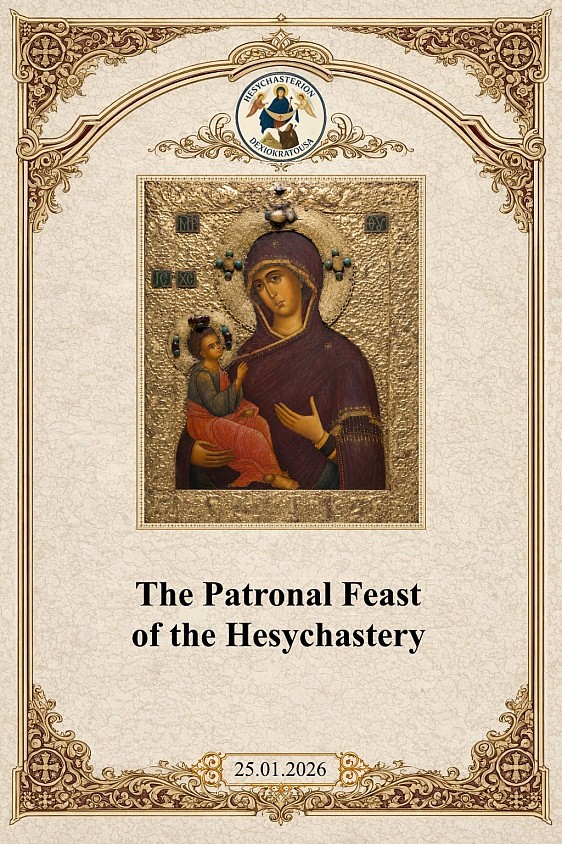
On its feast day, the Hesychastery prayerfully venerates the Most Holy Theotokos Dexiokratousa, placing its hope in Her intercession and mercy for the whole world.
Hesychasterion Dexiokratousa
25.01.2026
MESSAGE FROM THE HESYCHASTERION on the Beginning of the Civil New Year
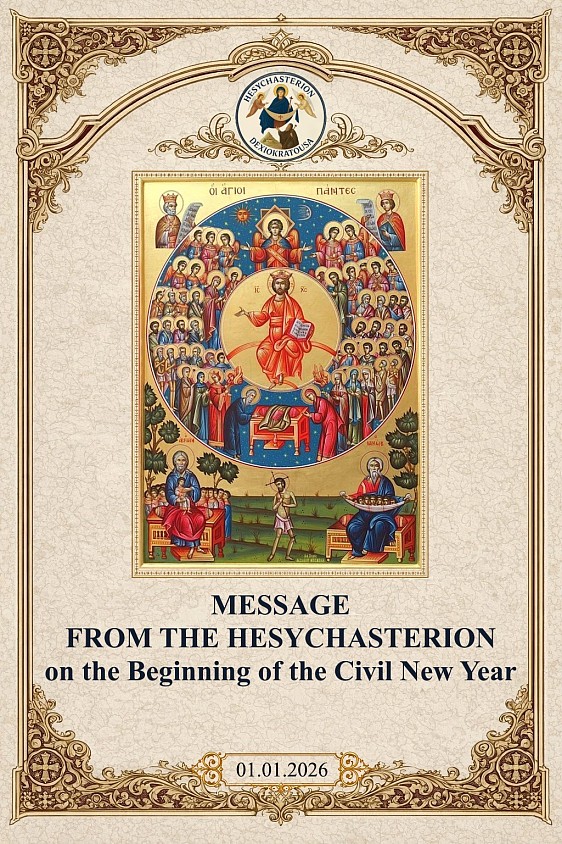
As we enter a new civil year, we are reminded that our days and years are not ruled by time itself, but are held in the hand of God.
For the world, the new year is simply a change of numbers; for the Christian, it is a reminder of how brief our path is, and of the need for watchfulness and repentance, so that each day may become an offering of thanksgiving to God.
The Hesychasterion, living in silence and prayer, does not celebrate the passing of time, but prays for those who live through it in labor, sorrow, and hope. We pray that the Lord may grant peace to hearts, strength to the weak, comfort to the afflicted, and light to those who seek the truth.
May the coming year be not a year of fear and distraction, but a time of peace, inner gathering, purification of thoughts, and growth in the love of Christ.
Entrusting all the faithful children of Christ to the mercy of God, the Hesychasterion bears witness: salvation is found in the stillness of the heart, in patience and faithfulness, and not in outward success.
With prayer for all who enter the new civil year, we remain in hope in the Lord.
Hesychasterion Dexiokratousa
01.01.2026
Message of the Hesychasterion for the Nativity of Christ
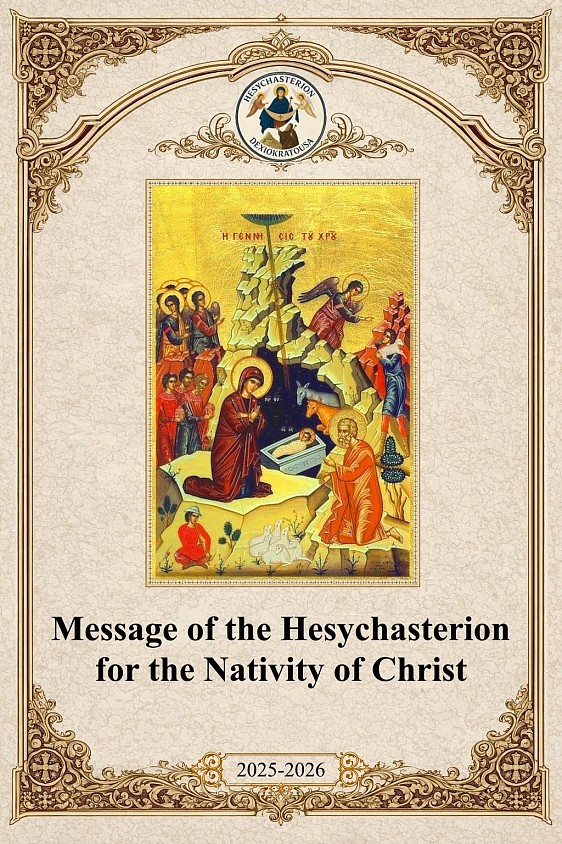
The Nativity of Christ is the silence into which Light enters.
Not by the noise of the world, but by the stillness of the manger, Life is born.
The Word of God humbles Himself, that the heart may learn to be silent and to attend.
He who preserves inner stillness shall behold the peace of Christ, brought by Him through His Nativity.
Hesychasterion Dexiokratousa
2025-2026
